
© 2026 بيديكس. جميع الحقوق محفوظة
العلامة التجارية بيديكس مملوكة لشركة يوروتك.
© 2026 بيديكس. جميع الحقوق محفوظة
العلامة التجارية بيديكس مملوكة لشركة يوروتك.
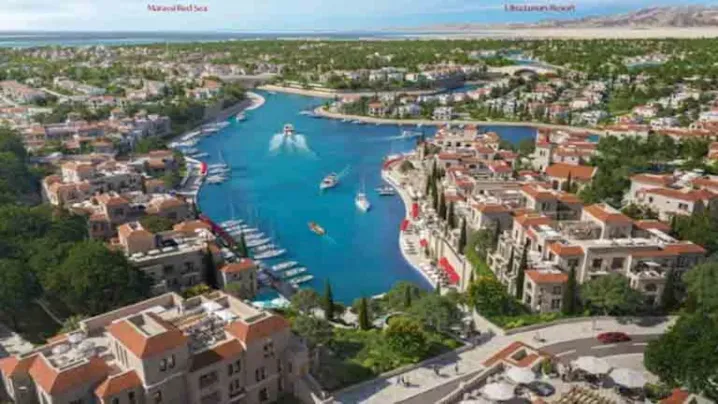
Egypt's eastern coast on the Red Sea is witnessing major transformations that reflect a change in the traditional concept of beach towns. Small seasonal villages or limited resorts are no longer the norm; instead, the ambition is greater towards establishing integrated cities that combine luxurious residences, long-term investment, and global connectivity.
At the heart of this transformation stands the "Marassi Red Sea" project as one of the most prominent examples of Egyptian and regional ambition to shape a new urban landscape on the Red Sea coasts, competing in size, quality, and boldness with famous international destinations like El Gouna and others.
The Marassi Red Sea project spans an area of approximately $2,426 \text{ acres}$, which is equivalent to nearly $10 \text{ square kilometers}$, in the Ras Soma area near Soma Bay.
It is located just $30$ to $40 \text{ minutes}$ from Hurghada International Airport, adjacent to the main coastal road network. This location was chosen after careful study of market needs and global trends in tourism and residential investment, aiming to be a permanent luxury tourism and residential magnet, not just a temporary summer retreat.
The enormous project is being developed by Emaar Misr, in collaboration with investors from the Gulf, with an estimated capital of about 900 billion Egyptian Pounds (approximately 18 billion US dollars). This reflects the magnitude of the ambition and the level of commitment to delivering a real estate product that makes a difference in the Egyptian and regional markets.
The master plan for Marassi Red Sea focuses on delivering a coastal city with integrated services and infrastructure, achieving the concept of year-round sustainable living, not just during the summer season. The most prominent design features include:
All these elements are designed to combine the beauty of the exquisite nature, the sophistication of hospitality, and the luxury of facilities, within a framework that considers environmental sustainability and effective operational efficiency.
What distinguishes Marassi Red Sea from previous coastal projects is its massive scale and comprehensive vision. The goal is no longer just to attract seasonal visitors but to establish an integrated city that lives and thrives throughout the year.
El Gouna has long been the gold standard for luxury living on the Red Sea, thanks to its integrated community, unique marinas, and advanced tourist infrastructure developed over many decades.
However, Marassi Red Sea comes with a completely new approach: it does not seek only to match El Gouna, but to present a bolder, larger, and more diverse model that targets the new generation of investors and residents, relying on accelerating the pace of execution and activating the infrastructure from day one.
El Gouna is a mature and stable city with an established residential base, while Marassi Red Sea is a modern project under formation, attempting to close the gap quickly through commitment to timelines, quality of finishes, and integration of services. Marassi's success in adhering to these standards will determine its ability to fast-track its development and achieve a competitive position to El Gouna and potentially surpass it in the future.
Marassi Red Sea represents an exceptional investment opportunity for buyers and investors in 2025 and beyond.
With increasing competition and growing demand for smart coastal cities in Egypt, Marassi Red Sea is expected to become a launchpad for similar projects in other coastal areas, which will raise quality standards and increase the flow of foreign investments over the coming years.
Despite all the success factors, the Marassi Red Sea project faces challenges related to the project's size and the massive investments required, in addition to economic fluctuations, exchange rates, construction costs, and the regulatory framework.
The advantages that make Marassi Red Sea a unique and exceptional project in Egypt and the region are numerous:
Marassi Red Sea is not just a new real estate project; it represents the beginning of a new era in the development trajectory of Egypt's coastal cities.
It is an investment in the quality of life, and an opportunity to build an integrated community that combines luxurious living, international hospitality, and long-term investment, in a stunning natural environment with ideal infrastructure.
The success of this project will determine the future of the coastal real estate market in Egypt, raise the standards of competition, and open the door for more mega-projects aimed at transforming Egypt's coasts into true global cities for living, working, and leisure.
All eyes are now on Marassi Red Sea, which may write a new success story worthy of Egypt's status and the aspirations of future generations.